Many DeFi users treat “don’t blindly sign transactions” as an exhortation rather than a practical workflow. It’s good advice, but it leaves a gap: what do you do when a complex multi-step DeFi operation presents itself inside a busy browser tab? The Rabby wallet extension reframes the problem from admonition to mechanism — it adds concrete, inspectable checkpoints (simulation, risk scanning, approval revocation) so a power user can convert caution into repeatable decisions. That shift matters most when you move beyond simple swaps into multi-chain flows, composable position management, and automation where a single mistaken signature can compound across chains.
In this guest-post case study I walk through how Rabby — the noncustodial wallet built by DeBank and available as a Chrome-compatible extension — changes the signing decision. I compare it to common alternatives, show where it helps and where it still fails to inoculate you, and give practical heuristics you can reuse the next time a vault withdraw or cross-chain bridge asks for an approval.
Mechanism first: what Rabby adds to the signing workflow
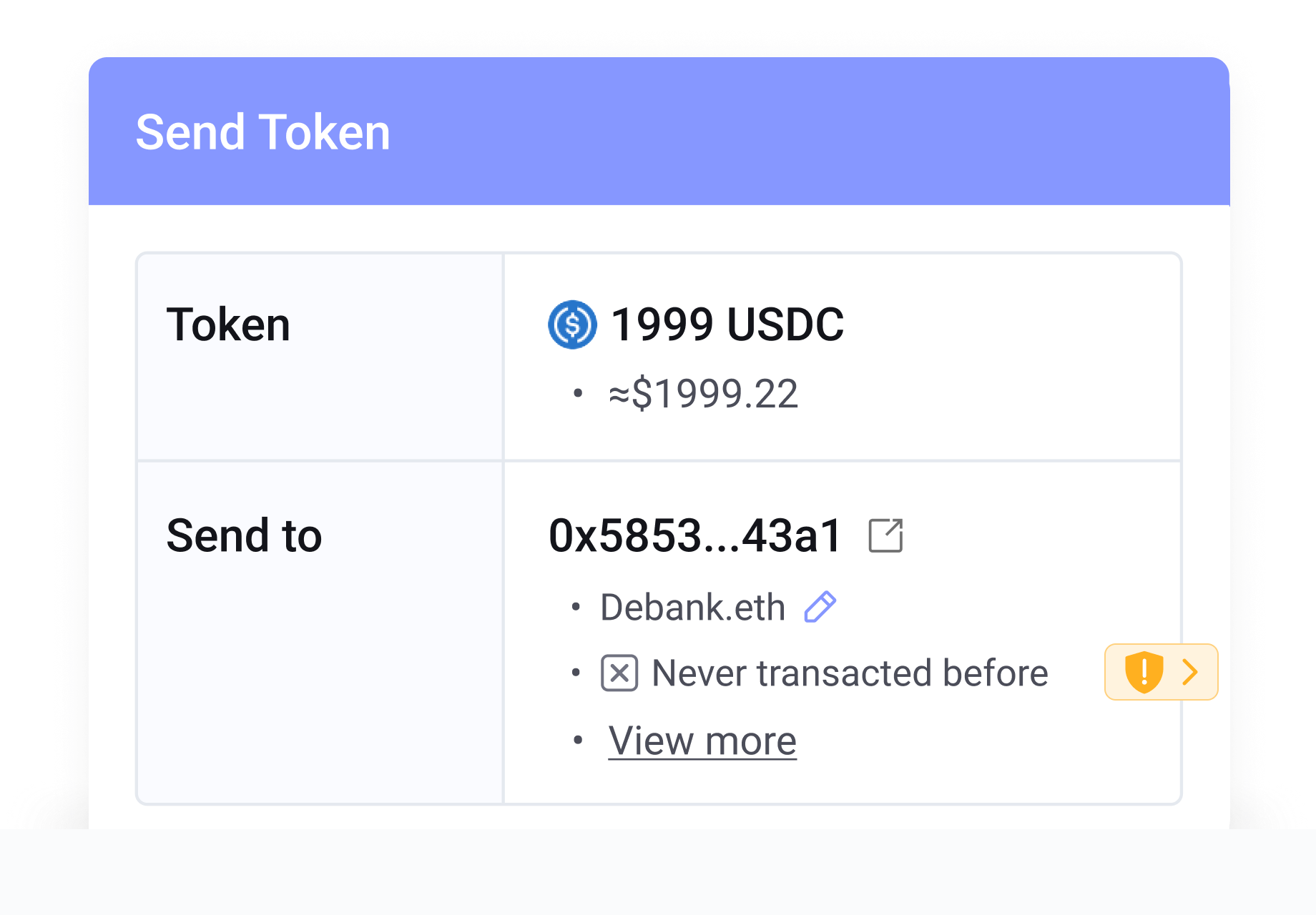
At its core Rabby intervenes before the cryptographic act of signing. Instead of surfacing a raw hex payload or a vague human-readable message, Rabby runs three coordinated mechanisms for each transaction you initiate from a dApp: a risk scan, a transaction simulation that estimates exact token balance changes and fee breakdowns, and a contextual UI to inspect and revoke approvals. Together these transform an abstract signing decision into a checklist: what contract will move funds, what approvals will it retain, and what will your net balances look like after gas?
Why that matters in practice: DeFi actions are rarely single-line events. A “zap” into a strategy can create temporary token approvals, call multiple contracts across chains, and leave lingering allowances. The simulation answers “what happens if I press confirm” with numbers; the risk scanner highlights past incidents or suspicious approval parameters; the revocation UI lets you close the door afterward. That three-part pattern is what distinguishes Rabby from wallets that only show gas and a button.
Case walk-through: a cross-chain LP withdrawal with approvals
Imagine you’re withdrawing liquidity from a Polygon pool, bridging part of the proceeds to Arbitrum, and then moving the remainder into a yield vault. Traditionally you’d face at least three separate signing events across networks, with manual network switching and piecemeal balance checks. Rabby’s automatic network switching and cross-chain gas top-up reduce friction: it detects the dApp’s target network and prompts the right chain, and — crucially for U.S.-based power users who run multiple chains in parallel — it lets you top up gas tokens on the destination chain so a follow-on transaction doesn’t fail due to zero gas balance.
Mechanically, the simulation step previews how many tokens are debited, what the bridge will deliver (estimates), and the fee on each hop. The risk scan will flag if any contract involved had a prior exploit or if an approval request is “infinite” rather than limited. Finally, after the operation you can open the revocation tool and cancel the allowance granted to the bridge or vault, removing a persistent attack surface. Each step shortens the cognitive chain-of-custody you must hold in your head — and that change is meaningful when you’re handling large or composable positions.
Trade-offs and limitations: what Rabby protects against — and what it cannot
Rabby’s defenses are systemic but not omnipotent. The wallet addresses three common failure modes: blind signing of complex calls, forgotten approvals that enable later drains, and failed cross-chain flows due to absent gas. These are frequent, high-leverage problems for power users, so mitigation here reduces common operational risk.
However, several boundary conditions remain. Rabby does not provide a fiat on-ramp: if you need to buy ETH with USD inside the wallet you must still use an external service. It also doesn’t provide native in-wallet staking primitives, so any staking still requires interacting with external contracts or a custodial service. Importantly, a transaction simulation is only as good as the state and assumptions it uses: simulations can be invalidated by fast-moving mempool conditions, frontruns, or oracle-driven logic that changes between simulation and inclusion. Simulations reduce uncertainty; they cannot eliminate it.
There’s also the perennial truth about open-source security: visibility helps but does not guarantee safety. Rabby’s MIT-licensed codebase allows independent audits and community review, which raises the bar, but it doesn’t automatically prevent misconfigurations or third-party contract exploits. This is not a critique unique to Rabby; it’s a property of noncustodial, composable DeFi systems. The 2022 Rabby Swap exploit that cost ~ $190K is evidence that even wallets and associated services can be targeted. The team responded by freezing the exploited contract and compensating affected users — a useful recovery anecdote — but it also highlights that wallet-level tools are part of a larger ecosystem that can fail in ways a wallet alone cannot fully control.
Comparing alternatives: where Rabby fits among MetaMask, Trust Wallet, and Coinbase Wallet
MetaMask is the de facto baseline: massive user base, broad dApp compatibility, and many third-party integrations. Its UX focuses on simplicity and wide support, but historically it has limited pre-sign simulations out of the box. Trust Wallet and Coinbase Wallet prioritize mobile-first ease and fiat pathways (Coinbase especially integrates with its exchange). Rabby explicitly trades some of that consumer convenience (no in-wallet fiat purchases) for security-oriented workflow features: transaction simulation, automatic network switching, approval revocation, and stronger multi-chain portfolio aggregation across 90+ EVM chains.
For a U.S. DeFi power user the decision framework looks like this: if you need simple fiat buy-ins and tight exchange integration, Coinbase Wallet or a custodial solution may be more efficient. If you want the broadest dApp compatibility and a lowest-common-denominator approach, MetaMask remains fine. If your workflow emphasizes multi-chain composability, cautious signing, hardware-wallet integration, and systematic approval hygiene, Rabby often reduces risk without imposing heavy new processes. That said, if you rely on in-wallet staking or fiat rails, you’ll need companion services.
Operational heuristics: a reusable checklist for signing with Rabby
Turn Rabby’s features into a habit by using this three-step heuristic that fits most DeFi flows you encounter:
1) Simulate first: always inspect the balance delta and explicit fee breakdown the extension shows. If numbers are missing or the simulation fails, pause.
2) Scan the risk indicators: treat flagged contracts as requiring secondary confirmation (read the contract, check multisig status, or prefer an established bridge) — not just a minor warning.
3) Revoke immediately: after multistep operations, use the built-in approval revocation to remove unlimited allowances. If you’re using a hardware wallet or multi-sig, prefer those for large-value positions.
What to watch next: signals that would change the calculus
Adopt Rabby more aggressively if it extends two capabilities: reliable, low-latency simulations that account for mempool dynamics (reducing simulation-to-inclusion divergence) and tighter fiat integrations without weakening the noncustodial model. Conversely, if future audits or incidents reveal systematic gaps in the simulation engine or in how Rabby integrates third-party contracts, re-evaluate how much you rely on automated scans. For U.S. users, regulatory clarity around on-ramps and custodial interfaces could also change the wallet landscape, but that would be a policy signal rather than a technical one.
FAQ
Q: Is Rabby available as a Chrome extension and how do I get it?
A: Yes — Rabby is available as a browser extension for Chromium-based browsers like Chrome, Brave, and Edge. For users who want a central entry to download and learn more, see this resource for Rabby: rabby.
Q: Will Rabby prevent all DeFi hacks or loss events?
A: No. Rabby reduces several common operational risks — blind signing, lingering approvals, and cross-chain gas failures — but it cannot protect against every vector. Contract exploits, oracle manipulations, and rapid on-chain state changes can still cause losses. Use hardware wallets, multisig for large holdings, and maintain good operational hygiene.
Q: Does Rabby support hardware wallets and institutional workflows?
A: Yes. Rabby integrates with Ledger, Trezor, Keystone, and similar devices, and it supports institutional and multi-sig solutions like Gnosis Safe, Fireblocks, Amber, and Cobo Wallet. These integrations are especially useful for U.S.-based power users who need custody separation or shared control.
Q: Are the transaction simulations foolproof?
A: Simulations are powerful but conditional. They model expected on-chain effects given current state; they can be invalidated by rapid market moves, frontrunning, or state changes between simulation and block inclusion. Treat simulations as an informed estimate, not an absolute guarantee.